
Gnewing Bore Gold Project
E 80/6105
***SOLD***
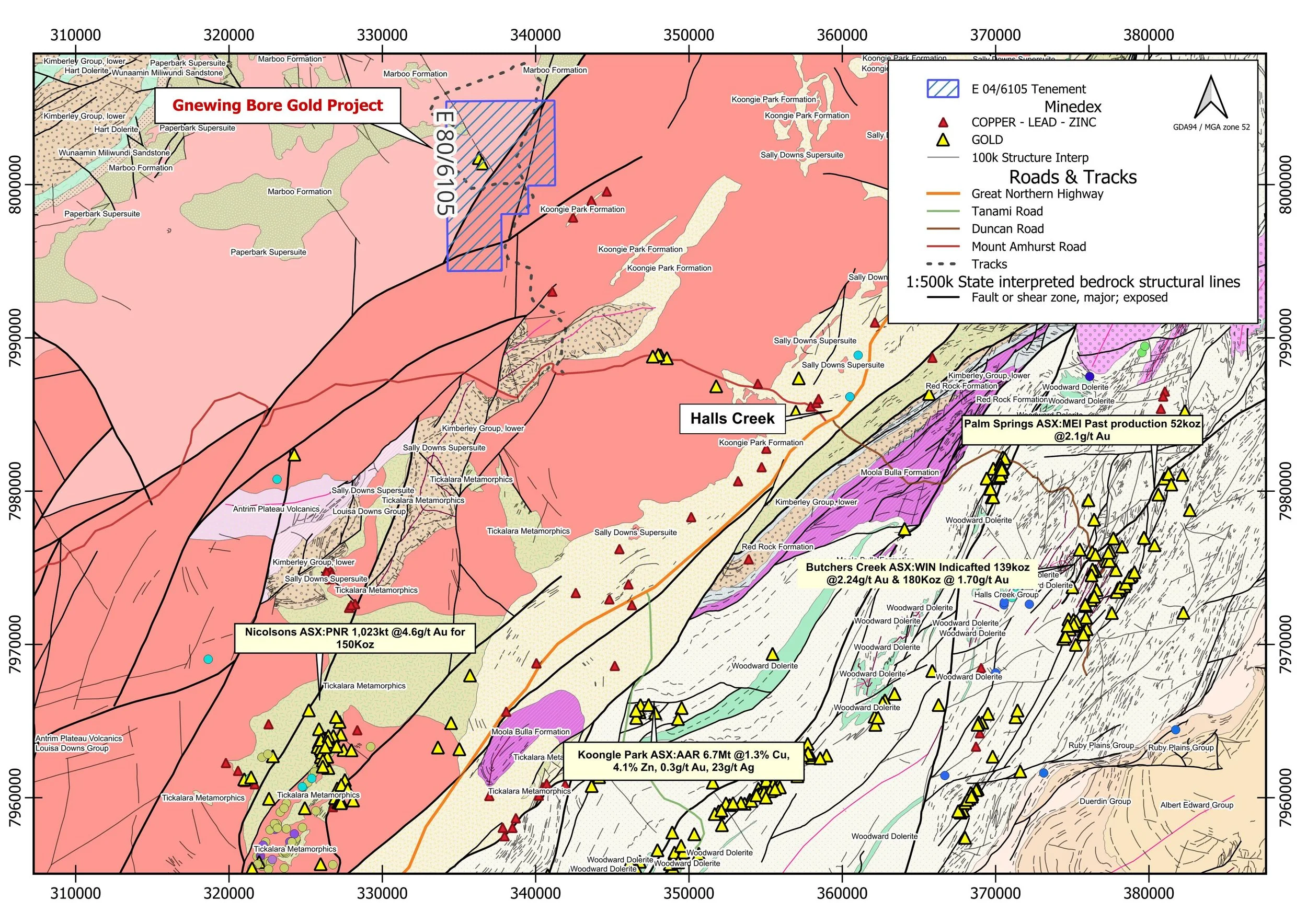
The Gnewing Bore Gold Project comprises Exploration Licence E 80/6105, located 29 km northwest of Halls Creek in the East Kimberley region of Western Australia.
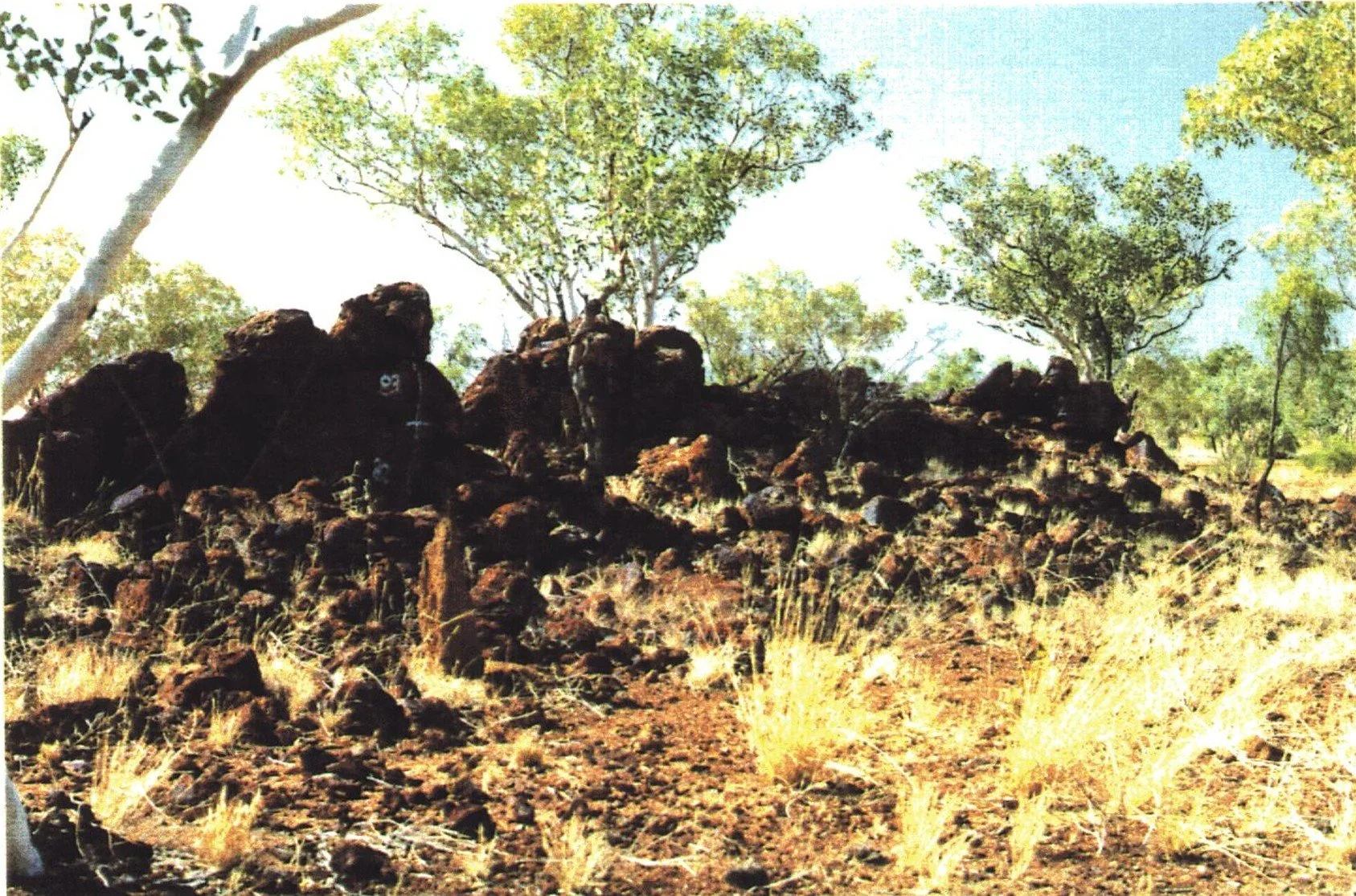
Exploration in the 1960s first recognized the area’s potential for gold and base metal mineralisation, identifying gossanous veins at the Gnewing Bore Prospect. However, little significant exploration has been conducted since the 1990s.
A review of historical data has highlighted untested potential for gold and base metal mineralisation.
Historical Gold Findings
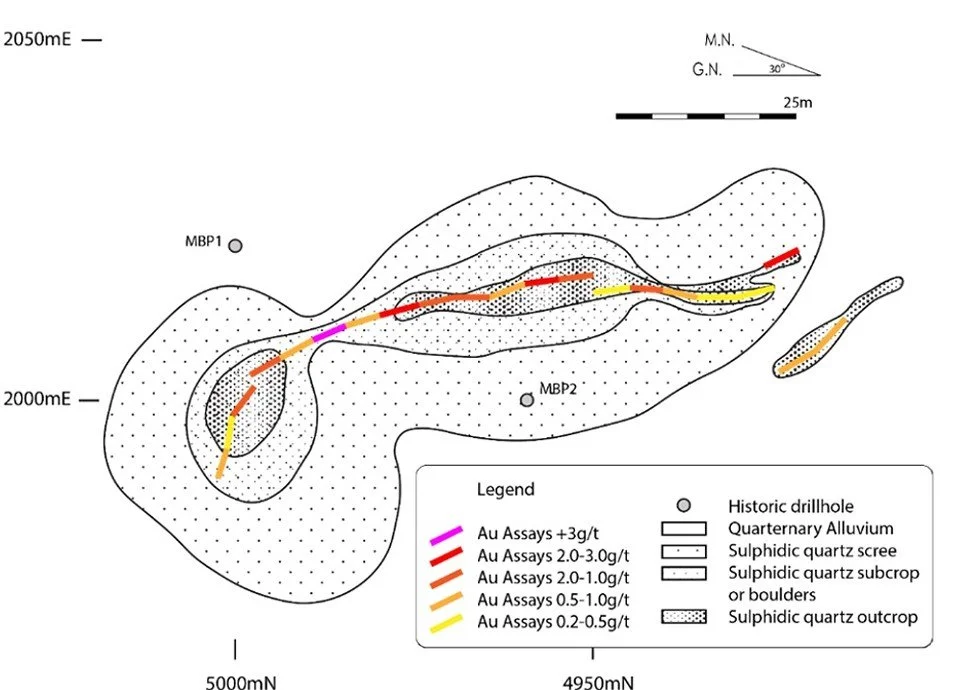
Quartz-sulphide outcrops and their narrow strike extensions were well defined by gold anomalism (A36766).
Composite grab samples from the strike extensions returned anomalous gold results, with values up to 3.85 g/t Au.
Semi-continuous 5m interval rock chip sampling along strike over the main quartz-sulphide occurrences returned results of 3.31 g/t Au over 5m and 1.63 g/t Au over 15m. A total of 10 samples over 50m returned >1.0 g/t Au, while 8 samples reported between 0.5 and 1.0 g/t Au.
Three historical drill holes returned anomalous gold intercepts:
MBP 1: 8m @ 0.52 g/t Au from 12m, including 2m @ 1.24 g/t Au from 16m.
MBP 2: 12m @ 0.33 g/t Au from 24m, including 2m @ 0.58 g/t Au from 26m
RAC Hole GB2: (8001282mN 335918mE): 3m @ 3.08g/t Au (sericitised and brittle fractured quartz vein) from 9m and 3m @ 0.792g/t Au from 28m (sericitised and brittle fractured quartz vein)
Below: Gnewing Bore Gold Project composite grab samples
Parallels with Local Gold Discoveries
Similarities can be drawn to the Nicolson's, Rowdies, Wagtail North, and Wagtail South deposits, all of which are associated with narrow, quartz-rich veins of varying lengths near the contact of a granite intrusive. Gold mineralisation is structurally controlled and hosted within shear zones, where a series of sub-parallel quartz vein shears are present. These shears consist of discontinuous, mineralised quartz veins that are typically fractured and brecciated. Arsenopyrite is the most prominent sulphide noted, with pyrite also being common. Chalcopyrite, galena, and sphalerite are present as minor to accessory minerals within the mineralised quartz veins. No sulphides are observed outside the quartz veins in the country rock.
Nearer to the surface, hematite, likely a product of oxidised sulphides, also appears in the wall rocks and quartz veins, resulting in weakly gossanous quartz veins or iron-rich sediment ridges that outcrop above the more subdued country rock.
Electromagnetic Survey
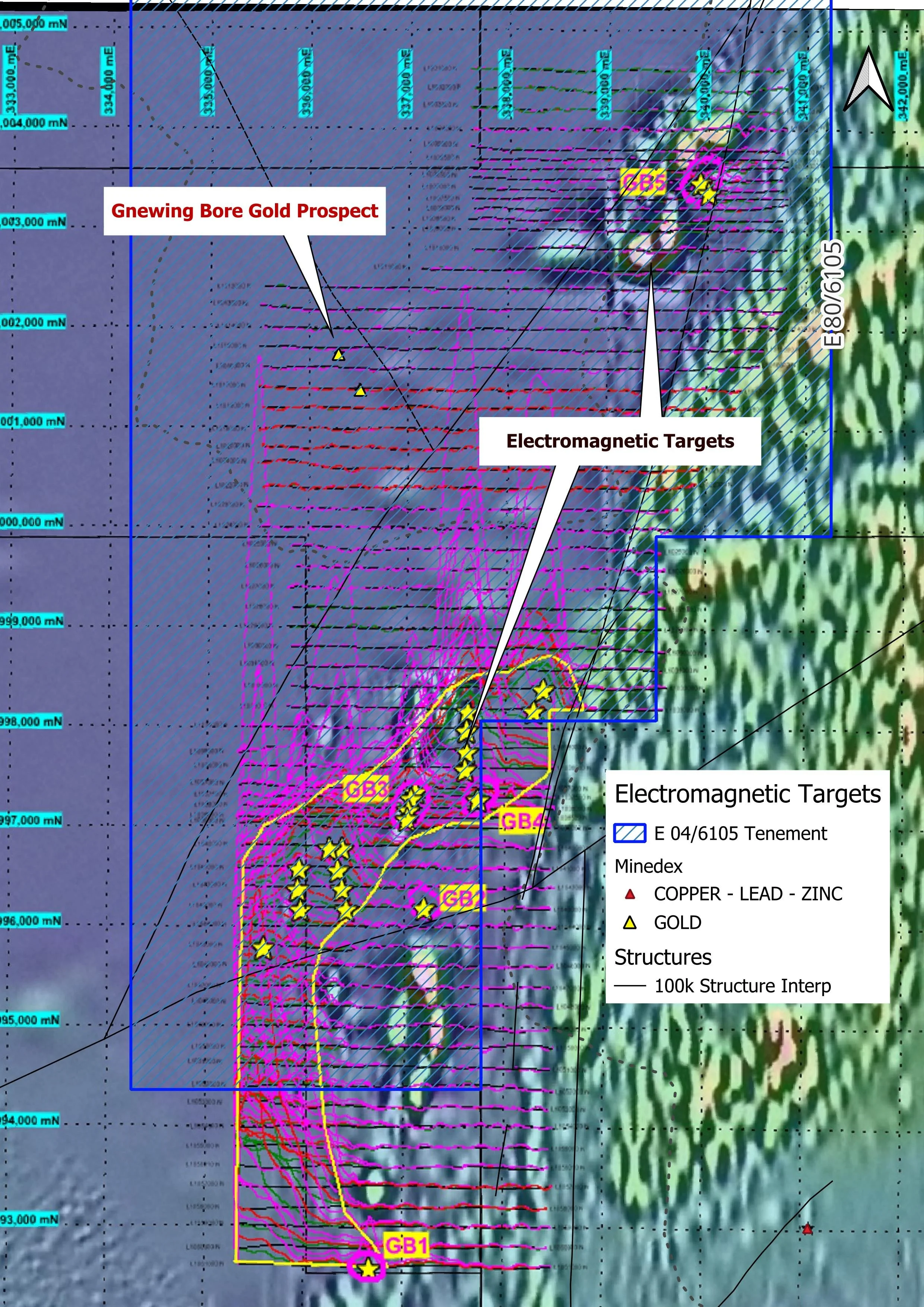
An electromagnetic (HTDEM) survey completed in 2022 identified five primary gold target anomalies: GB1, GB2, GB3, GB4, and GB5.
The primary objective of the survey was to explore for conductive, well developed sulphide bodies that may represent high grade, copper gold mineralisation or Ni-Cu±PGE mineralisation.
Rock Samples:
Sample 34554: Located on the eastern strike extension of the quartz sulphide vein at 4580N/2010E, It returned 2.27g/t Au with 1.02% As. note the small size of the outcrop (A36766).
Sample 34555: 1.08g/t Au, 1030ppm As
Sample 34556: 1.02 g/t Au 1241ppm As
Sample 34590: Located on the western strike extension of the quartz sulhpide veining at 5055N/1990E, returned the project high composite rockchip of 3.85g/t Au and 2.05% As.
Five meter semi continous rock Sample 34561 at the far eastern end of the main outcrop returned 2.46g/t Au with 105g/t Ag, 1.52% Pb, 875ppm Cu 3644ppm As.
Five meter semi continous rock chip sample number 34576 located in the saddle between the two main outcrops of quartz sulphide returned 3.31g/t Au. 0.55% Pb and 3025ppm As.
The quartz sulphide pods/veins occur at the lithologic contact between the granite and the dolerite and is likely related to a northwesterly trending structure.
A number of northwest- and north-northeast-trending structures are present and cut across the granitic rocks. Some of these structures contain quartz veins, mafic dykes. and gossanous quartz- breccia dyke-like bodies (e.g. Gnewing Bore gossan and Eagle Ridge quartz vein). These high level hydrothermal (epithenmal) quartz veins (Plates 5A & B) have been multiply brecciated and may have locally overprinted mafic dykes that occupy the same structures (Plates 6A & B) (refer Appendix 1, 706409, 706410 & 706417). (A43228)
*Page Under Construction*